Sétimo Dia
Seventh Day
Solo Exhibition
Curated by Ana Anacleto
CAV, Coimbra, 2021
Photograph by Photodocumenta. Courtesy of CAV - Coimbra
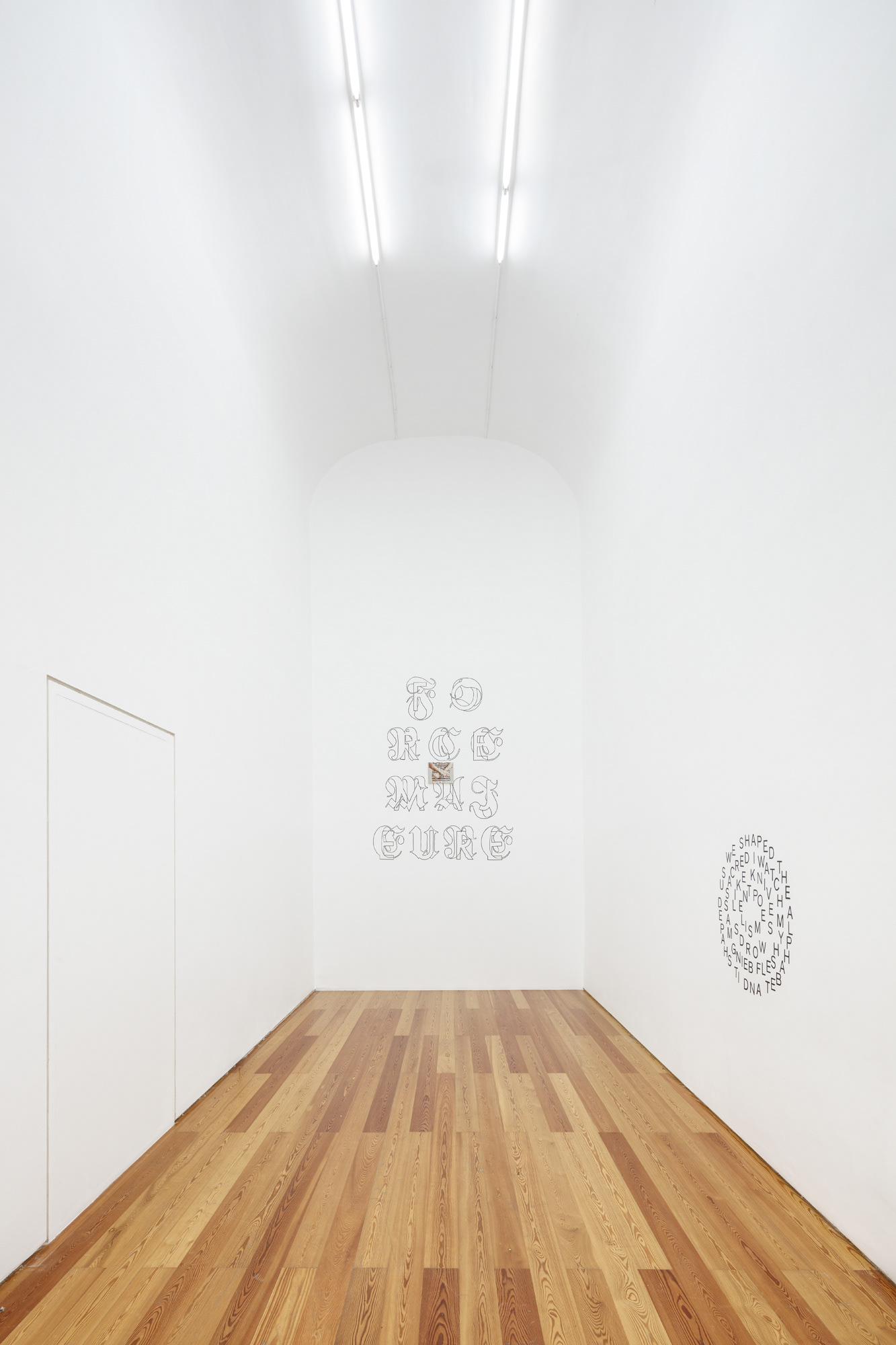
Created for the Seventh Day exhibition, this work dialogues with the history of the space and its previous use. The exhibition space, in the Visual Arts Centre in Coimbra, was originally a chapel in the palace of the Inquisition, dating back to the late 17th century. The exhibition room is a narrow rectangle with a high ceiling and vaulted roof. On the large back wall, I painted a typographic composition with the phrase “force majeure” and over it I placed a painting with hands crossed in a position of surrender or submission. Force majeure is an expression used in a legal context to refer to the suspension of any agreement between parties and, simultaneously, in a religious context, to an inexplicable act attributed to a divinity. The title of the exhibition refers to the idea of the end of a cycle and return, but also to the day set aside for rest. The works presented reflected on these ideas in a relationship between word and body/gestures, perception and interpretation.

Photograph by Photodocumenta. Courtesy of CAV - Coimbra
Force Majeur
Concrete poem, acrylic paint on wall, 2021

Ritual
Oil on linen canvas, 25x30 cm, 2021
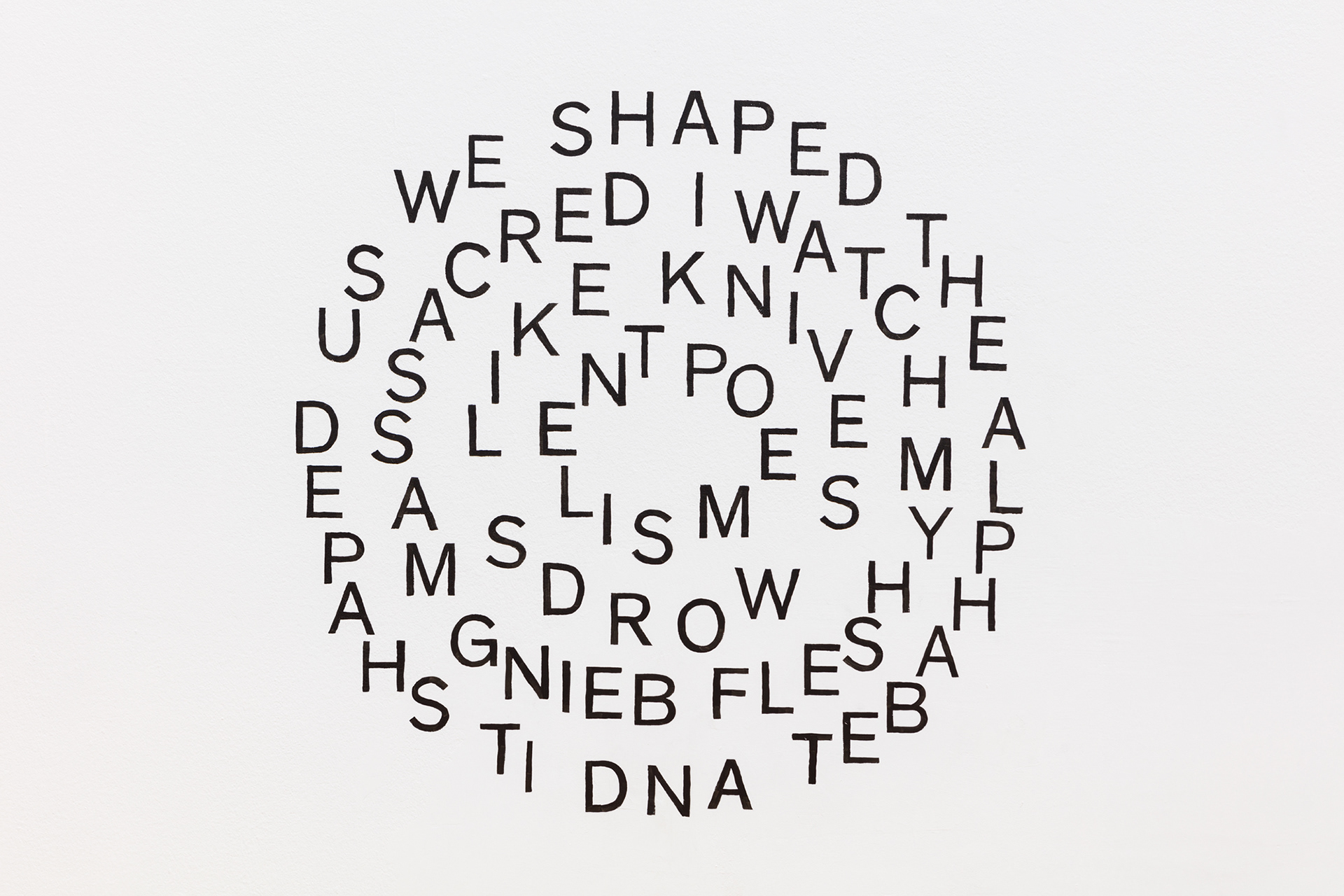
Propósito
Concrete poem, acrylic paint on wall, 2021

Photograph by Photodocumenta. Courtesy of CAV - Coimbra
Photograph by Photodocumenta. Courtesy of CAV - Coimbra
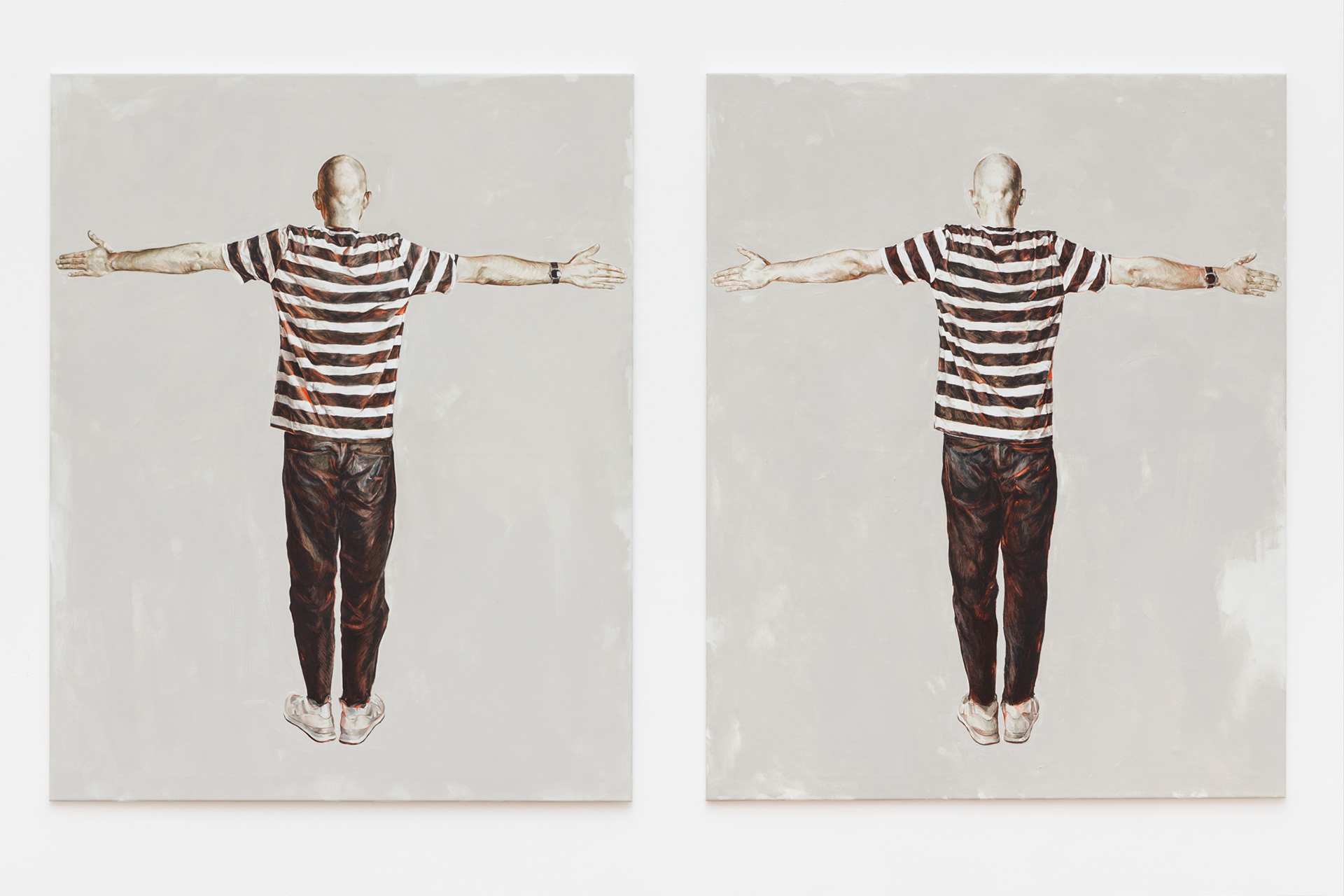
Ceremony
Oil on linen canvas, 150x120 cm each, 2021
Photograph by Photodocumenta. Courtesy of CAV - Coimbra
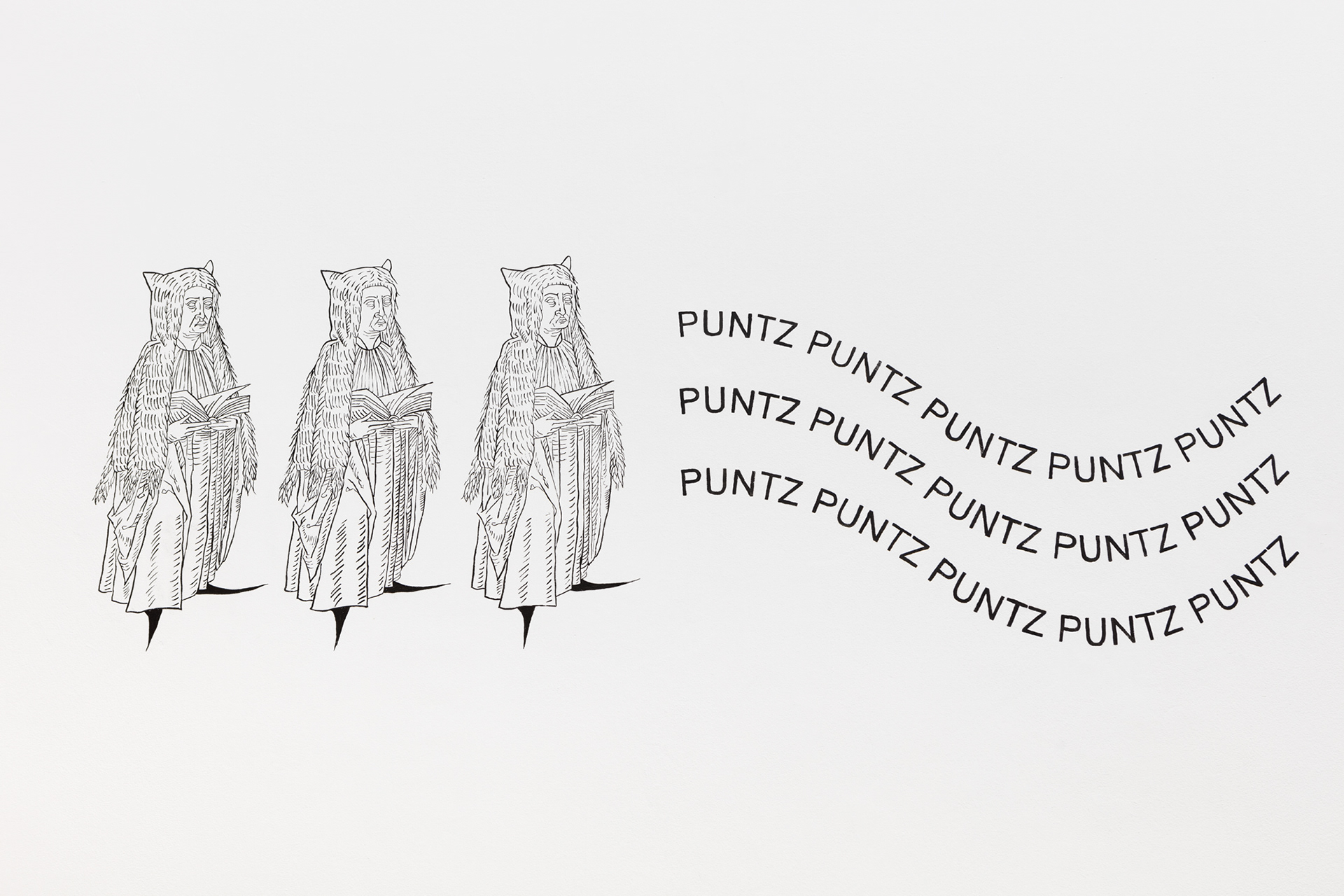
Coro Alto
Acrylic paint on wall, 2021
Seventh Day
by Ana Anacleto, 2021
Continuing his thorough investigation into painting, its practice, its ramifications and the mechanisms inherent, on the one hand, to its conception and, on the other, to its perception and understanding, Horácio Frutuoso set out to conceive a new body of work specifically for the context of the exhibition in the CAV Project Room.
Under the title ‘Seventh Day’ – a religious reference inherited from a Judeo-Christian tradition that points to the seventh day as the day set aside for leisure and rest – brings together a set of pictorial interventions that challenge the viewer's perception, inviting them to delight in and allow themselves to be drawn into an exercise in deciphering promoted by the various elements that make up the installation. We are talking about a spatialised practice of painting, in that it invades the space, expands beyond the usual limits of the canvas and attaches itself to the architecture itself – promoting a possibility of reformulating the idea of support – and challenging the viewer's gaze by summoning its presence in constant movement, in a game of highs and lows, fullness and emptiness, proximity and distance, familiarity and strangeness.
In his installations, we recognise a proposal for coexistence between various instances of the image and we clearly see an attempt to blur the hierarchies that usually elevate the domains of visuality to the detriment of the domains of textuality. Here, text is also image, and image is also text.
Perceiving, testing, proposing a possible reading of words simultaneously as images, or seeking to understand the narrative, textual, evocative and eminently poetic potential of images is the exercise that the artist asks the viewer to perform. And that time may be invested in it, summoning a certain deceleration of the gaze and promoting the idea of painting simultaneously as a territory of illusion and unveiling.
The intervention at the CAV is permeated by an idea of suspension. This pause and interruption of activity contained in the exhibition title is very present, for example, in the two interventions positioned opposite each other at each end of the room. On one side is Force Majeure (which alludes to the expression used, in a judicial context, for the suspension of any agreement between parties and, simultaneously, in a religious context, to an inexplicable act attributed to a deity) and on the other, the diptych Ceremony, in which the duplicate representation of a body (which we recognise as being that of the artist) seems to be suspended in spatial emptiness (also as if for reasons of force majeure), establishing a direct relationship with the architecture – seeming to be present there and simultaneously elsewhere.
Through the reuse and appropriation of images – combining references from a wide range of contexts, from medieval engravings to phonetic language, studio photography to the rhythmic combinations of poetry – the artist seems to approach the methodology of sampling, in a manner similar to the compositional processes of contemporary electronic music.
The delicate balance between the solitary anguish of failure and the determination of will and persistence inherent in the practice of painting – as developed by Horácio Frutuoso – gives this discipline immense power of resistance in relation to the voracious and insidious presence of the universe of images as we know it today, delicately and seductively bringing it closer to the realm of transcendence.